Adsense

Thursday, July 2, 2020

White fragility and what may be an unusual conversation at the fireworks tent

I can think of a few situations, a couple I've written about on this blog, in which something happens that just seems weird like maybe its got God's fingers in it.
Or maybe it is just coincidence.
Or maybe it is me doing what my high school students say I do ALL.THE.TIME with literature, which is reading too much into something.
The blue curtains are simply blue curtains and not metaphors for something else.

Yesterday, I finished reading White Fragility, which is all about how conversations about race make white people 50 kinds of uncomfortable.
The premise is that when white people are forced into having these conversations (because they often don't willingly do so) and must recognize their own racism, they then get angry or upset or cry or do other things to not deal with their own racist thoughts, actions, or reactions.

I've been thinking about my own experiences and conversations about race and how I have acted or reacted.

Today, I went to the fireworks tent near my house to pick up sparklers and pop-its that the kids throw on the ground.
I walked up and greeted the people who were running it, all of whom were Black.

There were one adult and numerous children (I'd say ranging in age from elementary to middle school).
(They had accents which made me think they are from Africa but I don't like to be nosy and ask because it is none of my actual business.)

The middle-school-age girls were very helpful, showing me different items, and the gentleman showed me things, but I told them that we're chickens and don't like the big fireworks.

I said that I'm the one who lights the fireworks, and I can't lose my hands because who will do the cooking?

When I was paying, one of the middle-school-girls was bagging my stuff and humming.
She asked me if I knew that song.
I asked her what it was.
She said it is a Christian song.
I said, "Oh."
She said, "Are you a Christian?"
and I answered, "Er....."

Because I was raised Catholic (which is Christian) and I half-assedly attend a Disciples of Christ church (which is Christian), but I don't think of myself as Christian because, honestly, a lot of Christians do a lot of not-even-remotely-Christian-stuff, and I don't want to be associated with them.

A lot of Christians do a lot of talking about being Christian, but they don't do a whole lot of acting like Christians in the way that I think Jesus would think is cool.

The girl saw me hesitating and said, "Am I making you uncomfortable?"
And I said, "No, it's just that I have some issues. I believe in Jesus, but I don't always like the church."
The girl then asked me about gay people and trans people, and I responded that I support them.
And I said, "I don't always like how churches treat women, for example."
This then led us to briefly discuss how Catholicism doesn't allow women to have a major role in the church as priests (which is just one of many issues I had with that particular brand of Christianity.)

And then I said, "I believe in treating people the way you want to be treated."
The gentleman said that this is the most important thing.

I couldn't help but think this conversation was sort of bizarre.
I meant it's not every day that people start conversations about religion with me.
But it was also bizarre because of its timing.
I was the sole white person at this tent.
The people who operated it were all Black.
The girl asked me questions about religion and asked me if they made me uncomfortable (which relates so much to what I'd just been reading about except in terms of race).
And we ended up discussing the Golden Rule, which I think has a lot to do with how white people treat Black people in both obvious and non-obvious ways.
Many white people do not speak about or to Black people in the same way that they would want to be spoken about or to.
They don't like the idea of Black people having the same opportunities as them even though if they traded positions, white people would want to have a fair shake at opportunities.


The video above is, to me, a pretty obvious example of white people not doing unto others as they would have others do unto them.

So, I don't really know what to do with this whole thing.
But I know I'll probably think on it for a good long time. 

Monday, June 29, 2020

Why I decided that unfriending people was the way to go

There came a time, I think it was in April, or maybe May, when I decided that I didn't need to be "friends" with certain people I know.
Heck, maybe I had made this decision by late March.

For a long time prior to this, there were people I was "friends" with whom I didn't actually like.
Mostly, they posted stuff like "Liberals this, that, and the other."
As if they know the hearts and minds of every single person who considers her/himself liberal-leaning.
Or they would post stuff about what Thomas Jefferson said about the republic, even though I know they didn't study history; they majored in business administration and maybe read a book or two about Jefferson.
Or they would argue with me, but arguing with me wasn't the problem.
It was their name-calling and willful fucking ignorance.
I can handle someone arguing me if they are presenting data or analysis or something more than, "But, but" and "Ok, then how about..."

I decided that in the world before FB existed, I would only raise my hand to wave at these people if I saw them in the neighborhood.
I wouldn't spend any time with them beyond a courtesy greeting once a year.
If I saw them out in public and knew they didn't see me, I'd probably also occasionally turn around and visit a different section of Home Depot to avoid speaking with them.

There is a whole mess of family that I am unfollowing and getting fairly close to unfriending since I haven't seen many of them since I was a child.
And they continue to post ridiculous stuff like "I don't see color" and "Christians are persecuted in the US" and other things that make me want to roll my eyes until they get stuck in the back of my head.

I had thought to myself that I was being open-minded by being "friends" with people who I strongly disagree with, but I finally decided that I was simply being driven crazy by people I don't actually care about.

And if I was gonna die during a pandemic or watch people die during a pandemic, I wasn't going to spend one extra second more than I had to being subjected to viewpoints that just make me angry.

I am all for having peaceful conversations because I am willing to learn from others and listen, but the truth is that there are some people whose minds are closed.
Having an argument with them is simply screaming into a void of nonsense or stupidity or derangement.

I determined that my own mental health was more important to me than making an effort to be "open-minded."

(I also deleted dead people because that just seems obvious.)

Saturday, June 27, 2020

Pandemic parenting expectations after reading a novel about a pandemic

I finished Station Eleven by Emily St. John Mandel a few days ago, and it made me feel much better about my inability and/or refusal to even attempt to make my kids' lives normal right now.

Normal is over.
And I don't know if this is temporary or permanent.

I do not have the mental energy to do anything more than keep my kids fed, relatively clean, and ensure they survive.
I'm not worried at all about whether their reading or math scores decline as a result of NTI this past spring.
I'm not worried that they aren't reaching whatever "potential" they might have.
I don't know that too many people right now are meeting their greatest potential.
Because self-actualization becomes not so critical in unique situations such as these.
Maybe there are some people, but I'm not one of them.

In St. John Mandel's novel, the pandemic that impacts the world kills somewhere around 99% of the population, and it does so within 48 hours, which I think is a mercy.
There are few things worse than unknowns and uncertainties as far as I'm concerned.
If COVID-19 were far more deadly, perhaps people would be taking it more seriously than they are.
Although I doubt it.

When my kids were younger, it was easier to have "engagement" summers.
They were happy to play in the backyard or go where I thought would be a fun spot.
Now they are older; they don't care, and I don't care enough to fight with them about it.
And during a COVID summer, my anxiety at being out among other humans, most of whom aren't wearing masks, is greater than my desire to have my kids doing self-actualization activities.
We won't be going to museums or malls or anywhere that we don't absolutely have to go.

A parent I interviewed for a magazine article recently said that either she or her husband go to the store "as tribute," which I thought was the most brilliant thing ever and am now applying to my life.

We have always kept the bar pretty low for entertaining our children, and I am so glad for that practice now.

As I read the aforementioned book, it occurred to me that kids in this pandemic mostly 1. died or 2. had to survive in ways that were probably horrible.
Their parents, were they even still alive, were far too busy finding food or drowning in their own psychological trauma to worry too much about their kids being engaged.

We had a meeting about field hockey, and while I will support N, I also am the type of person who doesn't like to invest too much effort and energy into something that seems fairly unlikely to happen.

This is, of course, the exact opposite of sports enthusiasts who want to be prepared and "ready to play" should the season actually happen.

My personal feeling is that the schools are going to find it difficult enough to figure out how to educate during COVID; I think they aren't going to think it is worth the effort, headache, and liability of extracurricular activities.
I just don't think they are saying this as yet.
But I suspect they will.

Whatever conditioning occurs will be an effort in "pretending to care about sports during pandemic" for me, although this, in truth, isn't too far from my normal "pretending to care about sports" status.

There is an awful lot of going through the motions for me now.
Which may also be permanent or temporary.
Uncertainty is cruel. 

Monday, June 22, 2020

The close-to-home vacation during COVID

We had originally, back in December, hoped to go to Yellowstone and Grand Tetons in 2020.
However, we had been hemorrhaging money in 2019 so decided a big trip was irresponsible.

In January of this year, I booked 4 nights at Land Between the Lakes in western Kentucky at a private home for June.

When COVID came along, we didn't know what we were going to do.
Eventually, we decided that since it was in-state, we wouldn't be violating any executive orders.
We also determined that even if we sat inside that house doing exactly what we'd been doing inside our house, it was, at least, a change of scenery.

We had planned to take my MIL, my niece, and my parents, but in March, April, and even May, we didn't know if that would happen.
Heck, to be honest, we didn't know how things would shake out for certain until we were on the road.

Ultimately, we told them that the five of us were going, and we left it up to them whether they felt comfortable going with us.

Our trip was nice.
We took our own food and never ventured to a restaurant even for curbside pickup.
I stopped in a small corner store for Hershey chocolate bars (for s'mores) and wore a mask.
I used my gas-pumping gloves the one time we stopped for gas.
We wore masks when we went into LBL buildings/nature stations and kept our distance from others.
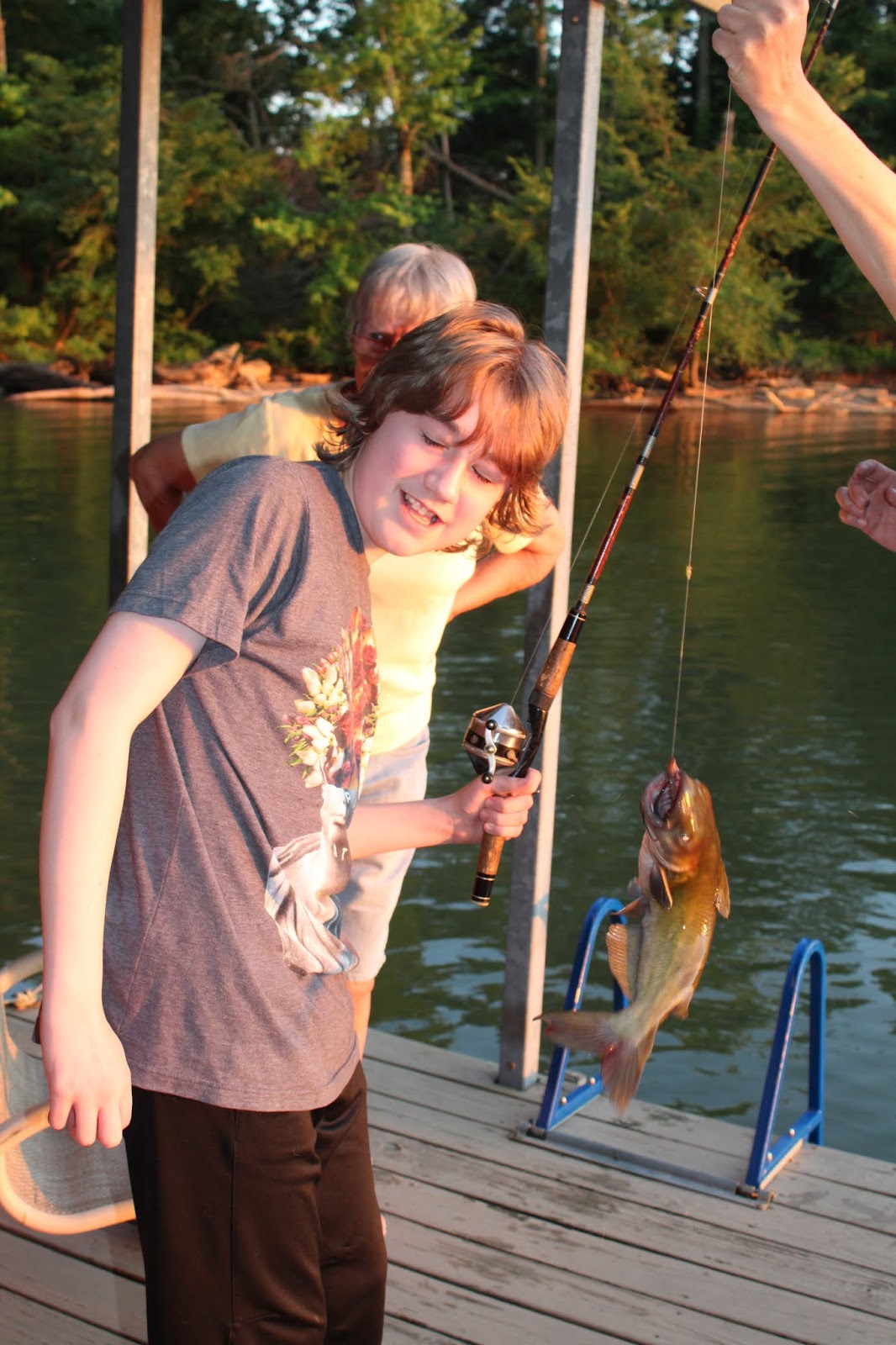
We spent most of our time at the house, swimming, fishing, kayaking, or eating.

Was it the most stellar, scenic, mind-blowing trip?
No.
Was it simple and relaxing and based on realistic expectations?
Yes.
And in a year like this one, that is downright delightful.

My thoughts on COVID have changed in some ways since March.
What hasn't changed is my feeling that it is serious, warrants life changes, and requires vigilance.
What has changed is my feeling that being careful cannot equate putting life entirely on hold.
If my parents, or kids, or I end up getting COVID, I will be glad to have had special memories of time spent together.


Fishing with Pa


 Masks were at the ready before we walked inside. 


Friday, June 5, 2020

Take your uncomfortable feeling and sit with it

Affrilachian poet Frank X. Walker published a poem this week.
Reading it made me feel uncomfortable.
That uncomfortable feeling was me recognizing that the poem's sentiment was honest and accurate.
What role do white women play in the raising of men who perpetrate brutality against blacks?

From my experience with OCD, I know that one of the ways to make it better or lessen its impact is to do what is called "sit with your anxiety."
Part of the reason people with OCD do their compulsions is to reduce the uncomfortable feelings they have.
The problem of giving in to the compulsion is that while it makes a person feel better for the moment, it makes the anxiety worse overall, which requires you to do more compulsions or new compulsions to make the anxiety go away.
"Sitting with your anxiety" is extremely uncomfortable but it is what is necessary to help truly master OCD and not be controlled by it.

I have seen at least two instances this week in which white women I know have posted their thoughts and/or feelings on social media regarding protests or wishing all this what they call "meanness" in the world would go away.
When their comments were challenged, they did not "sit with their feelings."
They deleted what they wrote and went back to "only happy, positive posts now."

While doing this may lessen their negative and/or uncomfortable feelings, it is indicative of white privilege.
They have the luxury of not dealing with the meanness of the world because of their color.
It is easy for them to slip back into the comfy, secure confines of whiteness where life is, perhaps not always easy or simple, but easier than if their skin color impacted how they were treated or viewed by others.

Sitting with the uncomfortable is, in my opinion, part of the hard work of understanding what your bias and prejudices are.
It isn't fun.
But it is necessary.

This week, a teacher friend posted the Harvard Implicit Bias Test.
There are numerous tests a person can choose, but I took the race one.
And before I took it I was scared.
I did not want to know what it would tell me.
What if what I thought I knew about my bias/prejudice was not accurate?
What if I had to look my bias/prejudice in the face and see myself for what I am?

And yet, that feeling of being scared that I felt was a luxury.
Feeling scared by what an online test will tell me about myself is so far removed from the feelings of fear that come from
driving while Black.
jogging while Black.
babysitting while Black.
eating ice cream while Black.
sleeping while Black.
bird-watching while Black.
kneeling while Black.


Tuesday, June 2, 2020

Language--what you say and what you think you say

I.
The other day, I wrote about code that white people sometimes use, and I gave "dirty" as an example.

As an English teacher and writer, I think a lot about the words that I use and the words that other writers use and how the use of those words impacts listeners and readers.

There is what is called denotation, the literal definition of a word.
There is also connotation, which is the understanding and usage of the word which may be similar to the literal definition or may be COMPLETELY different from the literal meaning.

The following words are all synonyms for the walk and describe how someone moves their body to get from one place to another.

roam
advance
sashay
shuffle

Even though these words all have the same denotation, they all connote something different. I would use the word "roam" if I was writing about trying to find my way in a city and not knowing where I'm going. I would not use sashay to describe how I get around an unknown city. Advance suggests military movement and strategy. I would not say I am advancing through the grocery store to get cereal.

When a white person uses the word "dirty" or "thug," they could be using the denotation of these words, or they could be connoting something totally different. Sometimes they do this unintentionally and sometimes they do it with cruel intentions.

Last fall, I used the word "dirty" to describe a certain type of blues music that I like. When I used that word, what I was trying to convey was a sense of rawness and stripped down(ness) to the music; music that had not been over-produced to sound full and "cleaned up."

After the words came out of my mouth, I realized that because I was talking about blue music, a form of music originated by black artists, my use of the word "dirty" could be, understandably, misconstrued from what I had intended.

Add to the fact that I was thinking about the music of The Black Keys, two white musicians, whose influences were Junior Kimbrough and Robert Johnson, two black musicians, and my usage of the word "dirty" became even further complicated.

At the time I said that, I didn't know The Black Keys were influenced by these men, but after I made that statement, I decided I needed to do some work. I began to research who they were influenced by and listen to those musicians.
I needed to internally give props to those musicians who maybe haven't gotten the credit they are due.

However many months later, I am still thinking about my use of the word "dirty," what I thought I meant by using that word, and what someone else might have understood.

II.
One of the dangers of social media is that it isn't a complete conversation and most people don't have the bandwidth to read an entire essay.
(Myself included, especially when there is no punctuation or separated paragraphs.)

Televised media is another example.
Why do people watch so much television?
Is it because the world and your understanding of it will be handed to you in short, digestible snippets?
But can we really understand anything from blurbs and soundbites and a 5-minute discussion?
For me, to understand means to read and read and read and think a lot after that and throw some experience in there, too.

So what social media has us do, myself included, is try to get everything we think into one statement, but one statement doesn't cover it.

III.
In trying to say everything we want to say in snippets, we add buts.
But is a conjunction intended to link two parts of a sentence together.

I like to eat popcorn, but it has an unpleasant effect on my digestive tract.
In the above sentence, I started out with a positive (I like to eat popcorn), but the "but" made it negative.
That is what buts can do.

Buts can also make a positive of a sentence that starts out negative.
I always hated tomatoes, but I have learned how to enjoy them on a salad.

The problem is that a lot of people are starting their comments as follows:
I support the protests, but I disagree with destroying property.
I think the police are too brutal, but I also think people need to follow their authority figures. 

The but takes your positive support and turns it into a negative, even if this isn't what you intended. Even if you say it in the spirit of goodwill.
Even if you really agree that things should change.
That but screwed up how your comment was received.

Are there other logical things potentially wrong with those statements above?
Sure, especially since some of the people who think POC should listen to authority figures are the same people who threw duck fits when authority figures instituted measures during the pandemic that impacted their ability to get their hair cut or select furniture at a discount store.

But this is simply about the power of the words we use and choose and the need to think about how our adjectives and conjunctions can impact how we are perceived.

Friday, May 29, 2020

I am so mad at white people right now

This is my blog to attempt to make sense of what I'm feeling.

I am angry.
I am sad.
I am ashamed.

All of these feelings stem from the deaths of Ahmaud Arbery and George Floyd and Breonna Taylor.
And they stem from the arrest of Omar Jimenez while trying to do his job.
And the video of Christian Cooper and Amy Cooper and her call to the police.
And the non-arrests or delayed arrests of Arbery's killers and Floyd's killers, as well as no-knock entries of police in the middle of the night.

But the cherry on top of the aforementioned shit sundae is the white people I know living in their white, upper-middle-class world and having not a clue that they don't have a clue.

I say this as a white person who knows damn good and well that I cannot possibly wrap my head around the POC experience.
Whatever I might think I know, I'm 100 percent sure I don't have even the slightest grasp.

"Violence doesn't solve anything" is the white person's lament that would be better said as, "I don't understand why black people protest and riot even though I did not say this same thing when armed white men went to the state capitol and screamed at law enforcement."
Unarmed POC are tear-gassed while white men with weapons that could reduce a crowd to dust are allowed to just hang out in the state rotunda.

"I don't understand why they're destroying their community" is another common refrain I've heard and seen. What this screams to me is, "I live on the other side of town than those people, and as a person who has been able to utilize business and economics to my advantage, I cannot imagine destroying something that provides me entertainment and a way to spend my disposable income."

How many freaking memes are about white women shopping at Target for fun while their husbands tailgate in the parking lot?
In the upper-middle-class white world, destroying a Target might get you a one-way ticket to hell assuming there is a hereafter. I like Target, but I know it screams "white person shopping place."

And just the fact that these statements say "their community" implies that you, as a white person, aren't a part of the person of color's community.
Even if shit is happening across your town, it is still your community.

I would be remiss if I didn't mention white people who do live all the way across town, some 15 miles from where protests happened in my city, commenting about gunshots at 3:30 in the morning near us.

I don't know how this appears to them; perhaps as concerned citizens of our little niche.
But in my frustration, all I hear is: "OMG, the chaos of the blacks is coming to our secluded little nugget of nirvana in the east end."

The comments of "This is horrendous" and chiming in on what you think you heard is the verbal equivalent of clutching your pearls.

Imagine hearing gunshots every night and not just on the night that a protest ended up in shootings?

Imagine being woken up at 3:30 in the morning because the police are ramming your front door down during a no-knock warrant? And then actually being shot?

Did you say "This is horrendous" when you saw the officer kneeling on George Floyd's neck?

What I want to say is "Will you PUHLEASE check your damn privilege at the door and quit freaking out about a non-event? You can walk down our street any time and rest assured that you are not going to be shot by anyone, and especially not a police officer."
Quit thinking about yourself when you have so many privileges you can't even begin to understand them all.

There are the white people who post a photo of an uplifting story about a friendship between whites and blacks and think this means they don't have a bias, implicit or otherwise.
Or because they have a black friend it means they don't have prejudices and don't have to do any internal wrangling and work about what racism is and how it impacts all of us.

If you have moved outside the school district or to another neighborhood in order to keep your kids at the "good" middle school, maybe you aren't as color-blind as you like to think you are?
(The whole notion of "Colorblindness" being part of white-people idiot-speak.)
Ahem, is the "good" middle school where there are more white kids?
Because while I'm pretty sure I don't understand the POC experience, I know white code when I hear it.
I have people in my family who stopped shopping at "dirty" Kroger even though it went through an extensive makeover and expansion.
I know what they meant by "dirty" Kroger.

This blog post was me reacting out of anger and frustration, and it is a terrible mess of lashing out and perhaps hurting the feelings of my white counterparts who read it.
Is it any wonder that the anger and frustration of POC has resulted in fires and looting.

Or does it explode? 
(White folks, this is code. Go Google it.)